
Product Details
| Category | Details |
|---|---|
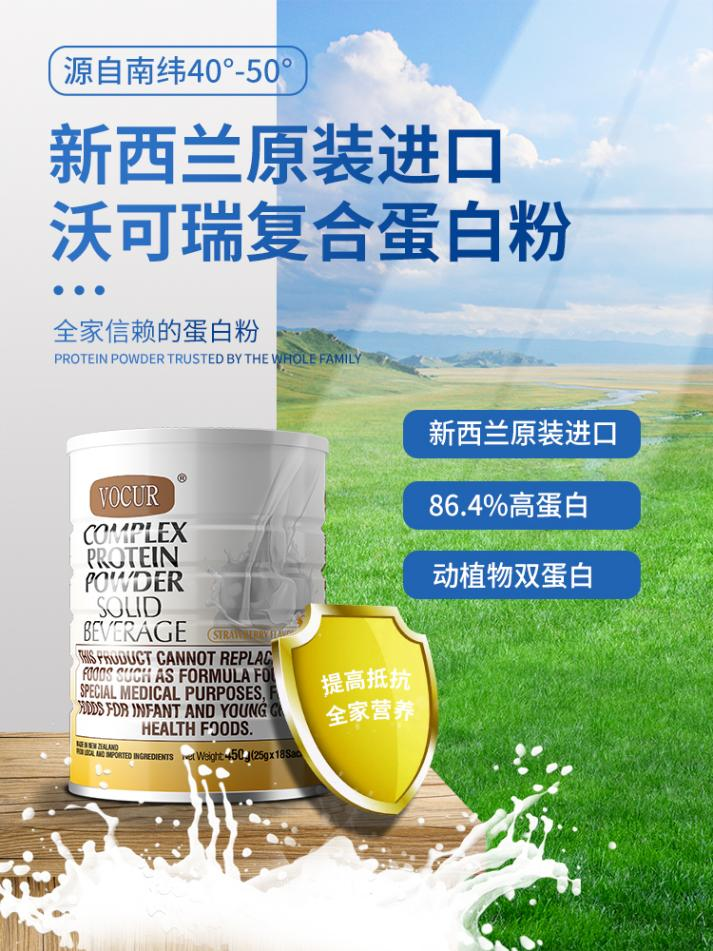
| Product Name | Compound Protein Powder Solid Beverage (Strawberry Flavor) |
| Ingredients | Soy protein isolate powder (73.9%), concentrated whey protein powder (24.6%), edible flavor |
| Origin | New Zealand |
| Net Weight | 450 g |
| Importer | Shenzhen Jinghuang Industrial Co., Ltd. |
Nutritional Information
| Nutrient | Amount (per 100g) | % Nutrient Reference Value (NRV) |
|---|---|---|
| Energy | 1659 kJ | 20% |
| Protein | 86.4 g | 144% |
| Fat | 2.9 g | 5% |
| Carbohydrate | 4.9 g | 2% |
| Sodium | 1162 mg | 58% |
I. Product Composition
Ingredients
Soy Protein Isolate Powder (73.9%), Whey Protein Concentrate Powder (24.6%), Food Flavouring (Strawberry Flavour)
II. Sources of the Principal Ingredients
Soy Protein Isolate Powder (primary plant-based protein) is derived from non-GMO soybeans sourced from New Zealand. Through a refined extraction process, the soybeans are transformed into a high-purity plant protein that contains no cholesterol and offers a complete amino acid profile, including all essential amino acids required by the human body. It is characterised by a high biological value.
Whey Protein Concentrate Powder (primary animal-based protein) is produced from grass-fed whey sourced from New Zealand’s renowned dairy belt between 40° and 50° south latitude. A gentle concentration and extraction process helps preserve the natural bioactivity of the whey protein.
III. Key Benefits
Physiological Functions of the Dual-Protein Formula
Whey protein supports muscle synthesis and helps reduce muscle loss
Rich in leucine — a key amino acid involved in muscle growth — whey protein activates the mTOR signalling pathway, thereby promoting skeletal muscle protein synthesis. For physically active individuals, it may help increase muscle mass and improve athletic performance. Among middle-aged and older adults, it may assist in delaying sarcopenia, the age-related decline in muscle mass and strength, while supporting mobility and functional capacity.
Soy protein isolate enhances satiety and supports body-weight and body-fat management
High in dietary fibre and macromolecular proteins, soy protein isolate slows gastric emptying and may stimulate the secretion of satiety-related hormones, prolonging the feeling of fullness. By helping to reduce overall caloric intake, it can support fat-loss regimens while preserving lean body mass and minimising muscle depletion during calorie restriction.
[1] Ji, X., Ye, X., Ji, S., Zhang, S., Wang, Y., Zhou, Z., Xiang, D., & Luo, B. (2025). Whey Protein Supplementation Combined with Exercise on Muscle Protein Synthesis and the AKT/mTOR Pathway in Healthy Adults: A Systematic Review and Meta-Analysis. Nutrients, 17(16), 2579. https://doi.org/10.3390/nu17162579
[2] Cereda, E., Pisati, R., Rondanelli, M., & Caccialanza, R. (2022). Whey Protein, Leucine- and Vitamin-D-Enriched Oral Nutritional Supplementation for the Treatment of Sarcopenia. Nutrients, 14(7), 1524. https://doi.org/10.3390/nu14071524
IV. Directions for Use and Suitable Consumers
Directions for Use
Consume one sachet (25g) per serving. Add the contents of one sachet to 100–150ml of warm water at approximately 40°C. Stir thoroughly until fully dissolved and consume promptly.
Suitable Consumers
Suitable for adults. Consumption frequency may be adjusted according to individual nutritional requirements. For general nutritional supplementation, one serving daily is sufficient.